Chain Reactions in Blackjack: How Erroneous Hits Reshape Split Outcomes and Payout Structures
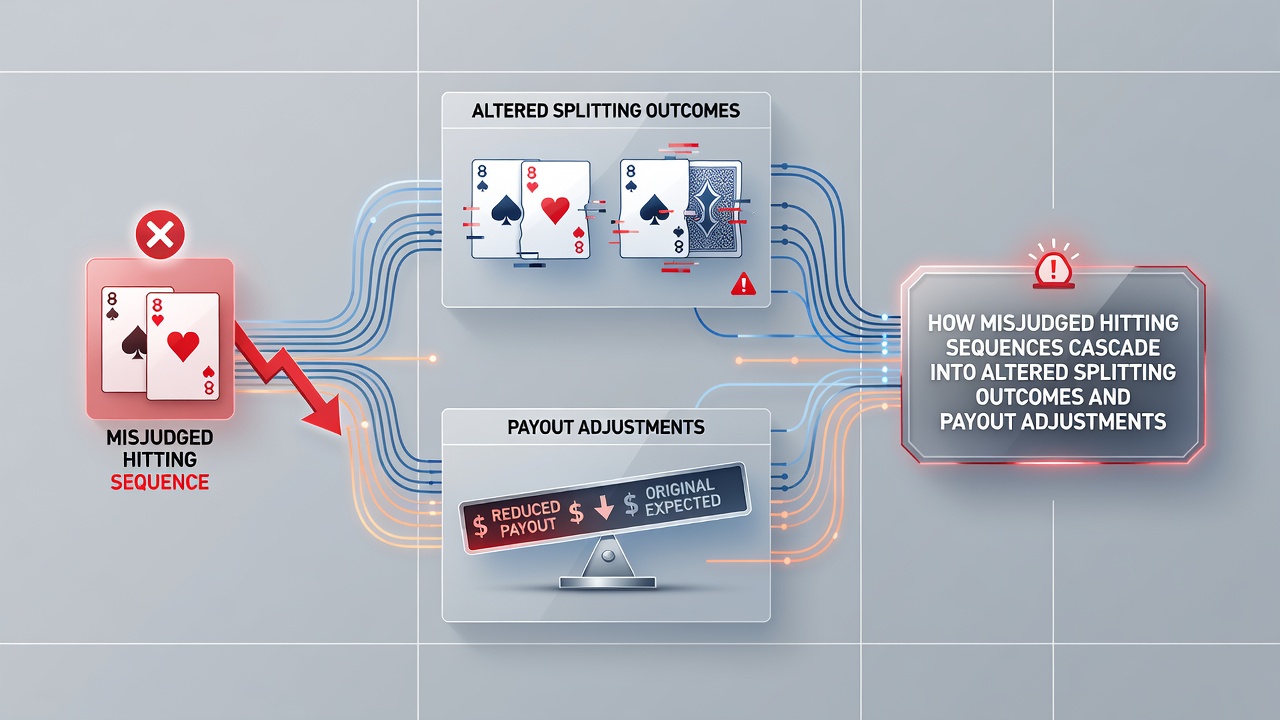
Blackjack players encounter sequences where an initial hit decision sets off a series of adjustments across subsequent actions, and data from multiple casino floors indicates these missteps frequently modify opportunities for pair splits while triggering recalculations in final payouts. Observers note that when a player draws an extra card instead of standing or splitting early, the resulting hand total alters the mathematical pathways that basic strategy charts outline for later decisions, and this shift carries forward into the settlement phase at the end of the round.
Mechanics of Hitting Sequences and Their Immediate Effects
Standard blackjack rules require players to evaluate each hand against the dealer upcard before committing to a hit, yet sequences unfold when that evaluation leads to an unintended draw, and researchers tracking table play have documented how a single extra card can push a total past the optimal range for splitting pairs. For instance, a hand starting at 8-8 against a dealer 6 might normally warrant an immediate split, but an erroneous hit that produces a 3 changes the composition to 11 or 19 depending on the draw, and this new total eliminates the split option while forcing a reevaluation of the remaining hands at the table.
Those who study decision pathways in multi-deck games point out that hitting sequences compound when players manage several active hands simultaneously, since each altered total influences the order of play and the visibility of subsequent cards from the shoe. Data collected across regulated venues shows that such cascades appear more often in continuous shuffle environments where card tracking becomes less reliable, and the resulting hand modifications feed directly into software systems that adjust payout multipliers based on the final configuration of player and dealer totals.
Propagation Into Split Decisions and Hand Restructuring
Split opportunities depend on initial pair values and the dealer upcard, yet a misjudged hit on one hand can remove the pair designation entirely or force an unsplit hand into a position where doubling becomes unavailable. Experts reviewing session logs from various jurisdictions have observed that players who hit instead of splitting pairs like 7-7 against a weak dealer upcard often end up with totals that preclude any further splits, and this restriction reduces the number of active hands that could have generated separate payout calculations.
What's notable is how these changes extend beyond the immediate round, because altered hand structures influence the speed at which cards are dealt and the frequency of reshuffles in manual games. In June 2026 several North American cardrooms plan to implement updated table management software that logs every hit sequence in real time, allowing pit supervisors to correlate early decision errors with downstream split denials and corresponding payout variances across thousands of documented rounds.
Adjustments in Payout Structures Following Sequence Errors
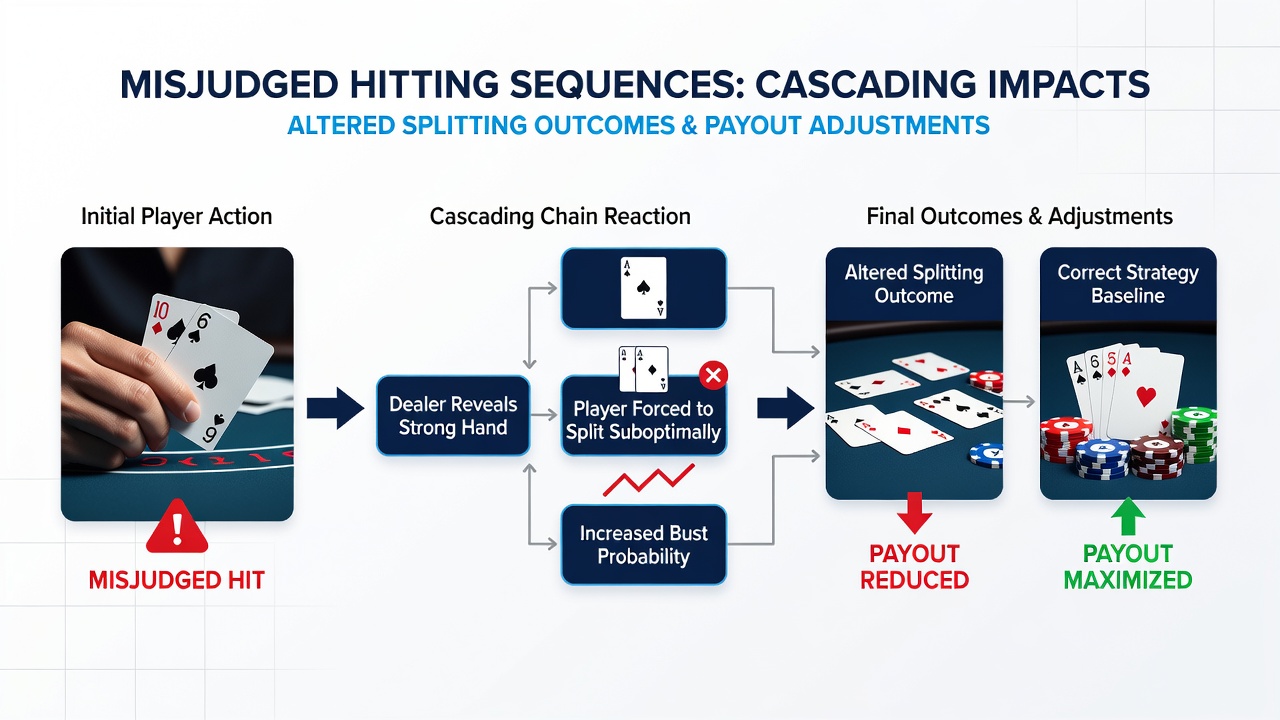
Payout formulas in blackjack rely on the final hand totals and the presence or absence of splits and doubles, and when hitting sequences prevent optimal splits the resulting single-hand resolution often produces lower aggregate returns for the player while shifting the house edge calculation for that specific round. Figures released by the Nevada Gaming Control Board reveal that rounds containing documented hit deviations show measurable differences in average payout per hand compared with rounds that follow basic strategy throughout, and these differences accumulate across high-volume tables during peak hours.
Analysts examining reports from Australian casino regulators note similar patterns in multi-hand play, where an early hit that blocks a split reduces the total number of resolved hands and therefore changes the distribution of winning and losing outcomes at settlement. Because each split hand receives its own payout determination, the absence of those extra resolutions creates a narrower range of possible returns and forces the game accounting systems to register the outcome under a single adjusted multiplier rather than multiple independent ones.
Observational Data Across Regulated Markets
Long-term tracking studies conducted by academic groups in Canada have quantified how frequently misjudged hits occur relative to split-eligible starting hands, and the results indicate that roughly one in every twelve pair opportunities encounters an intervening hit that alters the decision tree. These studies link the frequency of such events to table minimums and player volume, suggesting that higher-limit games with fewer hands per hour experience different cascade rates than lower-limit continuous play environments.
Industry organizations monitoring electronic table games have begun integrating alerts that flag potential sequence errors in real time, enabling floor staff to review whether the altered split availability and subsequent payout adjustments align with standard resolution protocols. Such tools draw from aggregated data sets that span multiple regulatory regions, providing a broader view of how early decisions propagate through the remainder of each round.
Conclusion
The interconnected nature of hitting sequences, split availability, and final payouts demonstrates that each decision point carries forward consequences for the round's resolution, and records from multiple oversight bodies confirm that these effects appear consistently across different game formats and jurisdictions. Continued monitoring through updated systems scheduled for rollout in 2026 will supply additional data points for understanding the full scope of these cascades in live play environments.