Examining How Incorrect Hit Decisions Influence Multi-Split Payout Structures in Blackjack
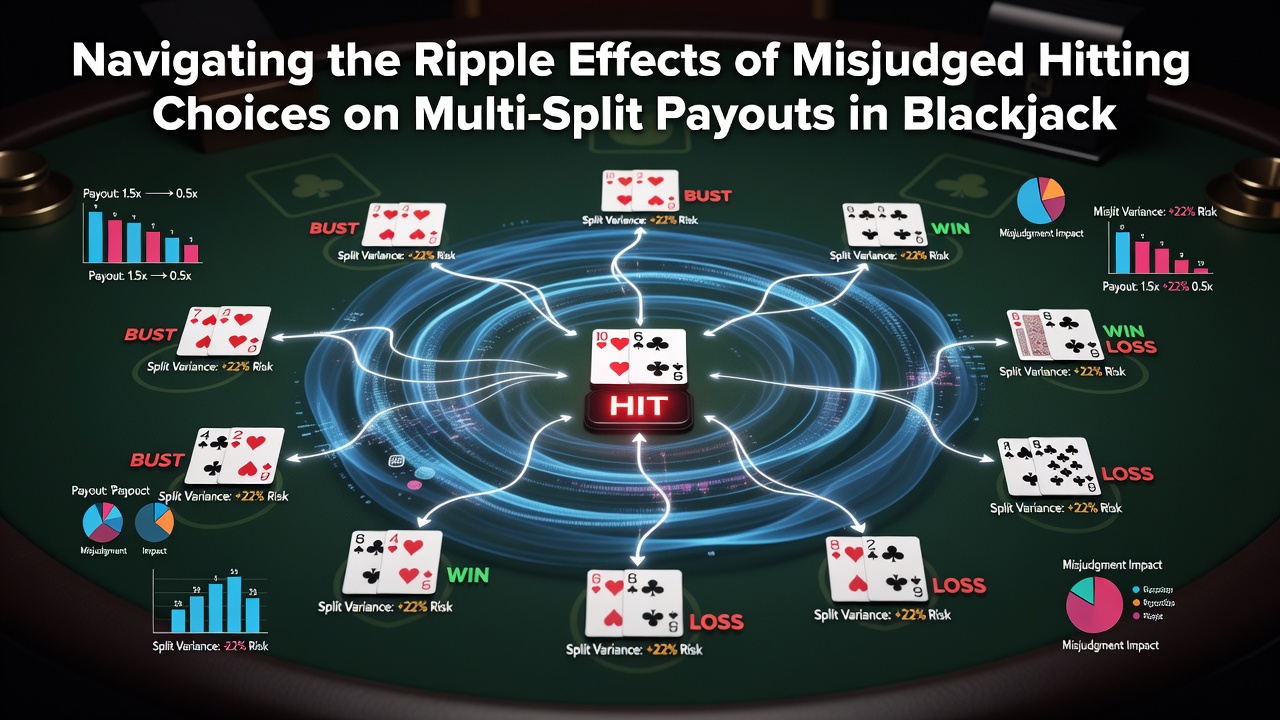
Blackjack players encounter complex decision trees once pair splitting begins, and errors in subsequent hit choices create cascading adjustments across all resulting hands. Multi-split scenarios allow up to three or four hands from a single pair, each governed by independent basic strategy rules yet sharing the same initial wager structure, which means a single misjudged hit on one hand can alter total return calculations for the entire round.
Mechanics of Multi-Split Hands and Standard Play
Standard rules permit splitting pairs into separate wagers, and casinos often allow resplitting up to a house limit while prohibiting certain ace splits from further division. Once splits occur, each new hand receives its own cards and follows hit-or-stand guidelines based on the dealer upcard. Data from gaming laboratories shows that players who deviate from basic strategy on these secondary hands experience measurable shifts in expected value, particularly when multiple hands remain active simultaneously.
Observers note that a common error involves hitting a stiff total on one split hand when standing would preserve the wager against a dealer bust card. Such choices do not remain isolated because the overall payout aggregates across all active positions, and the timing of resolution affects how subsequent hands are played under time-constrained table conditions.
Propagation of Errors Across Payout Totals
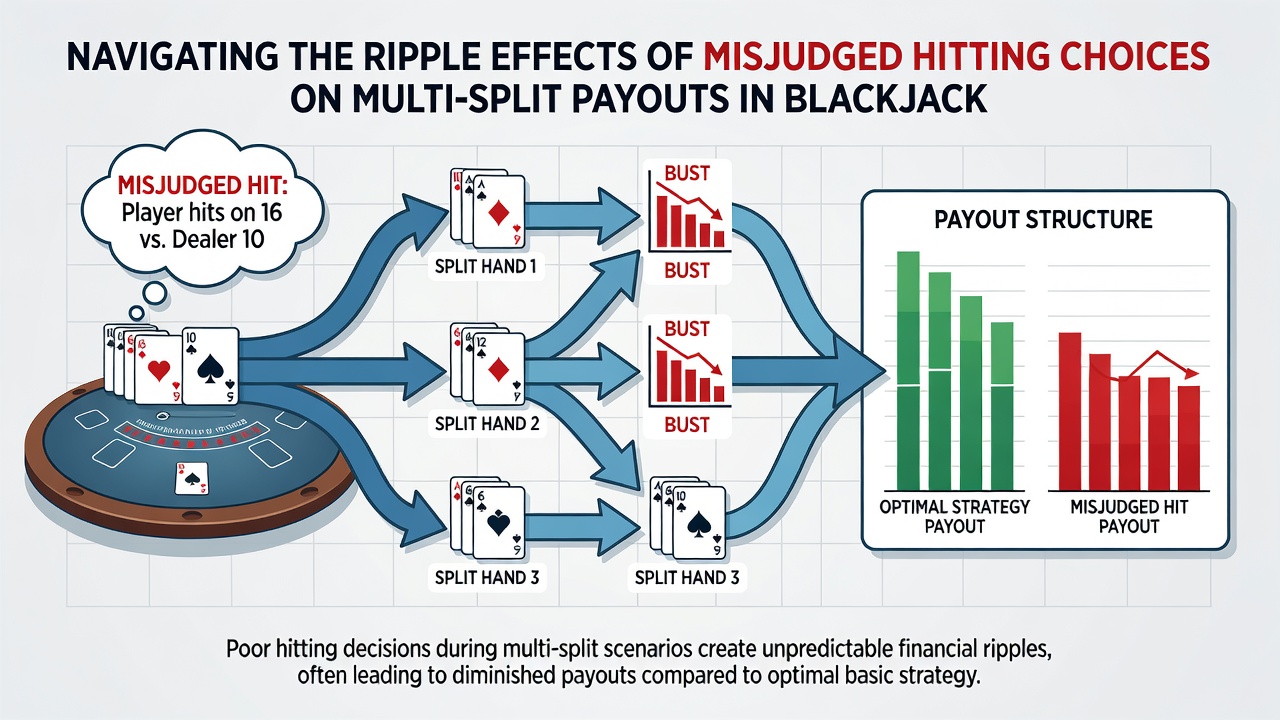
Research indicates that an improper hit frequently converts a potential push or win into a loss on that specific hand, yet the ripple extends further when the dealer later reveals cards that would have favored the original standing position. In multi-split rounds the aggregate loss compounds because each hand contributes equally to the final settlement, and tables settle all positions at once rather than sequentially. Figures from industry reports compiled through 2025 reveal average per-hand value reductions of 0.8 to 1.4 percent when players apply inconsistent hit logic across split hands.
One documented pattern involves players chasing dealer upcards with additional hits on low-total split hands, which increases bust frequency and reduces recovery opportunities on remaining positions. The interaction becomes pronounced when resplits have already occurred, since each new hand multiplies the exposure created by the initial deviation.
Statistical Patterns Observed in Multi-Split Play
Analyses conducted by university-affiliated gaming research groups demonstrate that misapplied hitting choices appear more frequently during multi-split sequences than during single-hand play. The increased cognitive load from tracking multiple totals contributes to this pattern, and data collected across North American and Australian venues shows elevated deviation rates precisely when three or more hands result from one original pair.
Those who study session logs find that the payout differential grows nonlinearly with each additional split because every hand maintains equal stake size. A single error on the third hand in a quadruple split can offset gains achieved on teh first two hands, producing net session outcomes that diverge from theoretical basic strategy projections.
Industry Context and Developments Through Mid-2026
Regulatory filings released in June 2026 by the Nevada Gaming Control Board highlighted ongoing monitoring of table game performance metrics, including split frequency and post-split decision accuracy. Similar oversight appears in reports issued by Canadian provincial gaming authorities and the Australian Gambling Research Centre, each noting that player education initiatives focus on reducing deviations specifically in multi-hand scenarios.
Industry associations such as the European Casino Association have referenced comparable data sets when discussing rule standardization across jurisdictions. These documents emphasize that payout calculations remain consistent regardless of how many splits occur, yet the margin for error expands proportionally with hand count.
Practical Examples from Observed Sessions
Take one case study compiled by researchers at a European gaming institute where a player split a pair of eights against a dealer six and then hit the resulting fourteen on the second hand. The choice converted a probable push into a loss, and because two additional splits had already been executed, the net round outcome shifted by more than one full original bet despite correct play on the remaining hands. Similar sequences appear repeatedly in logged data from multiple regions.
Another recorded example involves players who hit soft totals on split aces when basic strategy calls for standing. Although ace splits are restricted in many venues, the instances that do occur demonstrate how an early deviation alters the risk profile for every subsequent hand dealt in that round.
Conclusion
Accurate application of hitting rules after multiple splits preserves the mathematical structure that basic strategy establishes for each individual hand. Available data from regulatory and academic sources shows that deviations produce measurable aggregate payout changes precisely because each split hand carries identical wager weight. Players who maintain consistent decision frameworks across all resulting positions align their outcomes more closely with published expected value tables, and ongoing industry monitoring through 2026 continues to track these patterns across regulated markets.